History

The Elk Cotton Mills

One hundred twenty-six years on Cotton Mill Road. This is the record of the mill, told as honestly as we can tell it.

It was built as the Elk Cotton Mills. In later years it was known as Elk Yarn Mills, and finally as Elk Spinners.

“Young doffers in Elk Cotton Mills.” Lewis Hine, November 1910. National Child Labor Committee Collection, Library of Congress.
The truth of this place

In November 1910, Lewis Hine photographed the children of the Elk Cotton Mills for the National Child Labor Committee.

Doffers were the children who changed the full bobbins on the spinning frames. Hine documented child labor across the country to build the case for reform.

Historian Joe Manning, who has traced many of the children in Hine's photographs, identified “Little Fannie” as Fannie Belle Sweeney (1903–1996). Her family later recalled that she and her husband worked as winders at the mill for most of their lives.

We include it because it is part of the truth of this place.

More from November 1910

The other nine photographs Lewis Hine made at the Elk Cotton Mills, held by the Library of Congress. Tap any photo to see it larger.

The whole force in Elk Cotton Mills.
Leo, 8 years old, picks up bobbins at 15 cents a day.
Little Fannie, 7 years old, helps her sister in the mill.
Young boy on a warping machine.
Superintendent and overseers.
Young spinners. The youngest boy runs two sides at ten cents each a day.
Young doffers in Elk Cotton Mills.
Group of spinners in Elk Cotton Mills.
The whole force, a second view.

Lewis Hine, November 1910. National Child Labor Committee Collection, Library of Congress. No known restrictions on publication.

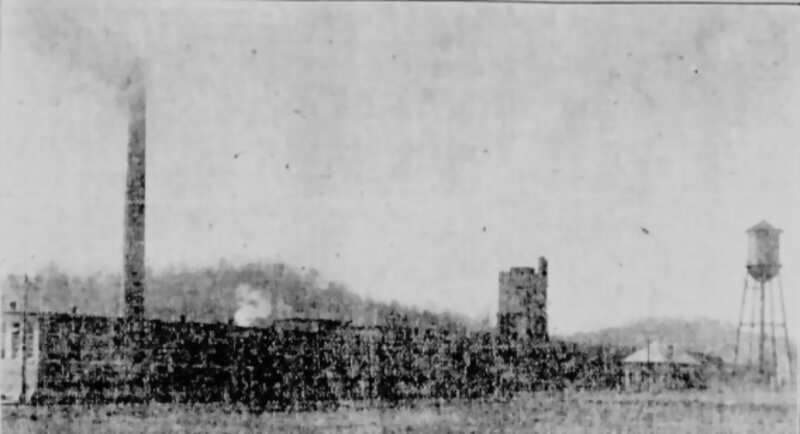
The Elk Cotton Mills in 1921: the long brick mill with its tall smokestack, the square sprinkler tower near the middle and an elevated water tank at the right
“Elk Cotton Mills.” Lincoln County News, Fayetteville, November 24, 1921, page 23. Public domain.

The mill in 1921

The county paper printed this photograph of the mill buildings in 1921, eleven years after Hine’s visit. You can pick out the tall smokestack, the square brick tower near the middle of the mill (it held the sprinkler tank in 1914) and, at the far end, a separate steel water tower that is no longer there.

Have a clearer copy, or an older photograph? We would love to see it.

From the Jim Cashion collection

Jim Cashion has spent years gathering photographs of Fayetteville and Lincoln County and sharing them freely with the public at jimcashion.com. These photographs of the mill, its people and its village come from his collection and are shared here with his permission. Thank you, Jim.

Captions follow Jim’s titles and what is written on the prints. Know when one was taken, or who is in it? We’d love to hear from you.

Elk Cotton Mills employees, 1902. The date and title are handwritten on the print.
Elk Cotton Mills employees, 1902, gathered at an arched doorway of the mill.
Tornado damage to the north end of the mill, 1909.
The Bright-Bagley home on Lewisburg Highway after the same 1909 tornado. In 1900 Mrs. Anna B. Bright sold the farm where the mill was built; we haven't yet confirmed whether this was her family's home.
The Elk Cotton Mill, smoke rising from the stack. Date not given.
The mill from across the rail line, labeled “Elk Yarn Mill – 1926” on the print.
Inside the mill, 1926: rows of spinning frames.
Mill employees, 1939 (left half of a panoramic photograph). The print reads “The Elk Cotton Mills, Fayetteville, Tenn.”
Mill employees, 1939 (right half of the same panoramic photograph).
The mill village, with the mill and its water tower behind. Labeled “Elk Yarn Mill – Cotton Mill Village.” Date not given.
The mill entrance, with the water tower. Date not given.
The Elk Cotton Mill in later years. Date not given.
Aerial view of the mill. Date not given.

Source: jimcashion.com, from the collection of Jim Cashion. Used with permission.

The story

From cotton field to Cotton Mill District

Pieced together from more than a hundred newspaper pages printed between 1900 and 1997, fire insurance maps and court records.

01 · 1879–1901

Built by the town

Fayetteville wanted a factory of its own. In 1900, twelve Lincoln County businessmen put up the money, bought a farm north of town beside the railroad, and built a steam-powered cotton mill in under a year. Several of them also led the town's Elk National Bank.

“The place selected for the house is in the center of a field of fine wheat.”
Chattanooga Daily Times, April 22, 1900
  1. 1879–1900

    The railroad comes to Fayetteville

    The Duck River Valley narrow-gauge railroad reached Fayetteville in 1879. The Nashville, Chattanooga & St. Louis Railway took it over and widened it to standard gauge in 1888. The mill was later built right beside the line, with its own siding.

  2. 1899

    Water for the mills

    Fayetteville built its gravity-flow water system, fed by springs, to serve the town's families and its mills.

  3. March 1900

    Chartered by the town

    Twelve Lincoln County businessmen chartered the Elk Cotton Mills with $60,000 of local money for a 5,000-spindle mill, and elected hardware merchant R. D. Warren president.

  4. March 1900

    The Bright farm

    The company bought about 150 acres on Fayetteville's north edge from Mrs. Anna B. Bright, in a valley just below the town reservoir. In April a railroad switch was staked off to the site.

  5. Spring 1900

    Stone and brick

    Stone was quarried for the foundations and Brogan & Scott took the contract for the brick. By late July the foundation was laid.

  6. Summer 1900

    The first houses

    Fifteen houses for workers went up beside the mill. The engine and boilers were ordered from Chattanooga, and electric lights were planned so the mill could run day and night.

  7. October 1900

    The first employee

    D. C. Anderson went to work for the company before the mill even opened. He stayed until 1942.

  8. Fall 1900

    Nearly finished

    The building was nearly done, machinery was arriving and water was piped in from the town reservoir. The mill was Fayetteville's biggest building project of the year, paid for with local money.

  9. 1901

    The spindles start

    The steam-powered mill began spinning cotton yarn in early 1901 with 5,000 spindles. It cost about $131,000, raised and spent almost entirely at home.

  10. November 1901

    Growing already

    Eight months after opening, the mill added 600 spindles. O. R. Smith of Georgia replaced A. B. Houston as superintendent.
02 · 1902–1914

A mill and its village

The mill paid its debts quickly and kept adding spindles. A village of company houses, a chapel and a boarding house grew up around it. These were also the years of child labor, a tornado and a new generation of leaders.

“The Elk Cotton mills sustained a loss of about $5,000, a part of the mill and engine room being demolished and the smokestack blown down.”
Nashville Banner, May 1, 1909
  1. 1902

    “Doing mighty well”

    New machinery was paid for out of profits, and an insurance agent called it the best-protected mill in the South against fire. Joshua Coons of Huntsville served as superintendent that year.

  2. 1904

    Owned by home people

    A county booster magazine called the mill the town's most important factory, with 65 hands and 6,000 spindles. Superintendent George F. Brietz married Inez Hatcher of Fayetteville that October.

  3. January 1905

    A new board

    H. K. Holman became president, J. H. Rees vice president, R. A. Rees secretary and treasurer, and J. B. McLaughlin manager. The construction debt was nearly paid off, and the company floated plans for an Elk River dam and a second mill. As far as we know, neither was built.

  4. 1907

    Ten thousand spindles

    The directors voted to grow the mill to 10,000 spindles. The village by then had its own church, the Elk Cotton Mills Chapel.

  5. March 1908

    A suburb of Fayetteville

    A smallpox quarantine at the mill village was lifted after every patient recovered. The Nashville Banner called the mill “a suburb of Fayetteville.”

  6. April 1909

    The tornado

    A tornado that killed thirteen people in Lincoln County blew off one end of the mill, wrecked the engine room and toppled the smokestack, about $5,000 in damage.

  7. October 1909

    Rebuilt and growing

    Six months after the tornado, about a dozen new cottages were going up at the mill, along with an addition and a new warehouse. The mill engineer Stuart W. Cramer of Charlotte supplied the plans and machinery for the expansion.

  8. November 1910

    Lewis Hine's camera

    In November 1910, Lewis Hine made ten photographs at the mill for the National Child Labor Committee, including its young doffers and spinners. Images like his helped build the case for national child-labor laws.

  9. 1911

    The Elk Cotton Mills village

    By now the papers simply called the neighborhood “the Elk Cotton Mills village,” with its own boarding house, weddings and news.

  10. April 1912

    The inspector's visit

    The state factory inspector reported that a group of children ran out the back door of the mill when he arrived. He could not prove the law was being broken and made no arrests.

  11. March 1913

    John Harrison Rees dies

    John Harrison Rees, one of the founders and president of both the mill and Elk National Bank, died of pneumonia. His son Ernest Rees would lead the mill for the next four decades.

  12. April 1914

    The fire insurance map

    The Sanborn Map Company mapped the mill for fire insurance: a long spinning room, a picker room and card room, steam engine and boiler rooms, a water tower, an office and three cotton warehouses on the railroad. See “The buildings” below.

  13. September 1914

    A second mill that wasn't

    The company announced plans for a “Mill No. 2” with 10,000 spindles and 200 looms to weave cotton duck, a heavy canvas. It seems to have become the 1915 addition instead.

03 · 1915–1930

The pride of Lincoln County

A big addition, more spindles and a steady payroll made the mill the county's largest factory. It bought local cotton, backed local farmers, fielded a baseball team and helped the town through a water famine.

“The plant has grown each year, and now is a true million dollars plant, and the pride of each Lincoln countian.”
The Nashville Tennessean, November 23, 1924
  1. 1915–16

    The big addition

    The mill decided on a 150-by-125-foot addition and 5,000 more spindles, at a cost of about $90,000. It was designed by J. E. Sirrine of Greenville, South Carolina, one of the South's leading mill engineers, and fitted with Whitin spinning machinery. It is very likely the twisting and shipping building that still stands at the north end of the main mill.

  2. 1921

    The mill in a photograph

    The Lincoln County News ran a photograph of the mill: a tall brick smokestack, a long mill building, a square tower and an elevated water tank.

  3. 1922

    Remembering the founder

    A Memphis newspaper profiled R. D. Warren, the Fayetteville hardware merchant who organized the Elk Cotton Mills before moving to Memphis in 1901.

  4. 1923

    More spindles

    The mill added 4,000 spinning spindles and 2,500 twister spindles. J. E. Sirrine & Co. again served as engineers.

  5. November 1924

    The pride of Lincoln County

    A Nashville paper counted 150 workers, 60 company houses and no company store, with wages a little above other local factories. The mill bought about 3,300 bales of local cotton a year, nearly half the county's crop.

  6. August 1925

    Mill baseball

    At the Lincoln County Fair, the Elk Cotton Mills baseball team lost to Merrimack Mills of Huntsville, 15 to 5. Mill teams played each other across the region.

  7. September 1925

    The water famine

    A drought left Fayetteville nearly out of water and shut the mill for two weeks. The men went to work laying the town's new water line from Tolley Spring, and the women were paid half wages until the mill reopened.

  8. December 1925

    Prizes for growers

    The mill put up $800 in prizes for a four-acre cotton growing contest. Most winners topped a bale an acre.

  9. 1926

    The guard's story

    The mill's guard, McCager W. Payne, told a Nashville paper his mother had married John Wilkes Booth in 1872. It is a well-known legend, not established fact.

  10. 1927

    First bales

    The first two bales of Lincoln County's 1927 crop were sold to the mill. Ernest Rees sat on the board of the state manufacturers' association.

  11. 1929

    A new boiler house

    The mill built a $35,000 boiler house with two new boilers.

  12. October 1930

    Ending night work

    The Elk Cotton Mills was among the first mills in Tennessee to back the industry's pledge to end night work for women and children.

04 · 1931–1959

A family mill

The Rees family carried the mill through the Depression and the Second World War, modernized it after the war, and in 1959 sold the company houses to the families who lived in them.

  1. 1931

    A test well

    An oil and gas test well, “Elk Cotton Mills Fee No. 1,” was drilled on the property. It found fresh water and a little gas.

  2. 1933

    The village church

    The mill village had its own congregation, the Elk Cotton Mills Church of Christ.

  3. 1933–34

    The banks fail

    All three of Fayetteville's national banks failed after the 1933 bank holiday, including Elk National Bank, which mill founders R. D. Warren and John H. Rees had once led. Depositors got back 40 to 77 cents on the dollar. The mill kept running through the Depression.

  4. 1935–36

    The cotton tax fight

    The company sued in federal court to stop the New Deal tax on processing cotton. After the Supreme Court struck the tax down, the mill received a refund of about $12,000.

  5. 1937

    The county's most valuable asset

    A letter to the Nashville paper called the mill Lincoln County's most valuable asset, with about 200 workers, and praised it for keeping people working through the Depression.

  6. 1938

    Child labor ends

    The federal Fair Labor Standards Act set a minimum age and maximum hours, ending the era of the child doffer.

  7. 1943–45

    Wartime

    Ernest Rees served on a regional War Labor Board panel, and his son Ernest Rees Jr. served as a Navy officer on destroyers before returning to the mill.

  8. 1946

    Backing young farmers

    Ernest Rees had given the $100 prize for the county 4-H cotton contest for seven years running.

  9. 1949

    Twenty thousand spindles

    At a banquet for workers with 25 to 49 years of service, the mill counted 20,000 spindles on two shifts of 160 workers, spinning fine yarn for automobile upholstery. That fall it let a $130,000 contract for new opener and picker rooms and a larger cotton warehouse, with $750,000 more planned.

  10. May 1951

    Ernest Rees Sr. dies

    Ernest Rees Sr. died at 75 after 45 years as the mill's manager and president. Mill workers carried his casket.

  11. 1956

    Standing up for Tennessee textiles

    Ernest Rees, then vice president, led Tennessee textile men to Governor Frank Clement over cheap imports and was named to the state's advisory council.

  12. July 1959

    The village houses are sold

    The company offered its 32 remaining company houses to the families living in them and put the money into the workers' pension fund.

05 · 1960–1997

The last decades

The company bought a second mill in North Carolina, took the name Elk Yarn Mills, and changed hands in a management buyout. Its last operator, Elk Spinners, closed the plant in March 1997.

  1. 1961–1968

    Growing beyond Fayetteville

    In 1961 the company bought Brewer Mills on Legion Road in Hope Mills, North Carolina, giving it a sister plant. By 1968 that plant was spinning polyester yarn, while Fayetteville kept spinning cotton. By then the company was known as Elk Yarn Mills, Inc.

  2. 1964

    Federal cotton payments

    The mill received $41,975.89 in federal “equalization” payments, part of a program that offset the high price of American cotton.

  3. 1966

    A national voice

    Ernest Rees Jr. was elected to the board of the American Textile Manufacturers Institute.

  4. June 1978

    Recorded by the state

    The Tennessee Historical Commission surveyed the mill, noting the one-story brick mill, its tower with a parapet, and about 32 houses of the old and new mill villages.

  5. August 1982

    The warehouse fire

    A suspected arson fire destroyed a small storage warehouse on the property. By then the company was Elk Yarn Mills, Inc.

  6. 1983–1984

    A management buyout

    Dick Whitmore, the company's executive vice president, led a buyout of Elk Yarn Mills' shareholders, ending the Rees family's ownership. At the time the company owned about 212 acres around the Fayetteville plant.

  7. December 1991

    Down to one shift

    Elk Yarn Mills, the city's oldest industry, cut its second shift, laying off 43 workers and keeping 82. President Dick Whitmore said the company meant to stay part of the community.

  8. October 1993

    The reunion

    More than 100 former workers gathered to share memories of the company church, the mill ball team, and the steam engine that ran every machine. It was organized by a group called the Friends of the Elk Cotton Mill.

  9. 1996

    Little Fannie

    Fannie Sweeney Henderson died at 92, a former Elk Yarn Mills employee. She is very likely the “Little Fannie” Lewis Hine photographed here in 1910.

  10. January 1997

    The announcement

    Elk Spinners, part of Uniblend Spinners of South Carolina, announced it would close the plant. The city and county had offered low-interest loans if it modernized, but the company's lenders would not invest more. Workers learned the news by letter and were invited to apply at Uniblend's South Carolina plants.

  11. March 1997

    The spindles stop

    Elk Spinners, the mill's last operator, closed the plant on March 10, 1997. One hundred nine people lost their jobs, ending nearly a century of spinning on Cotton Mill Road.

  12. June 1997

    The sister mill closes

    Three months after Fayetteville, the company's sister plant on Legion Road in Hope Mills, North Carolina, closed on June 27, 1997. It was the last yarn-spinning mill in Cumberland County.

06 · 1997–today

A second life

The spindles are gone, but the buildings stand. New owners bought the empty mill in 1998, and its former workers still gather each fall to remember it.

  1. 1998

    New owners

    Norris Properties LLC, owned by Dick Farrar Jr., his father Dick Farrar Sr., and Bill Carter Sr. and Jr., bought the closed mill. They repaired the roof and wiring and rented space for warehousing, a gymnastics business, and indoor practice for high school teams.

  2. May 2001

    The auction that wasn't

    The owners offered the 143,500-square-foot mill and 206 acres at an absolute auction on May 5, 2001, but called it off when only six bidders came.

  3. After

    A second life

    The buildings found new uses as warehouse space, a gym and community events, including a Humane Society attic sale in “the century-old mill” in 2001 and estate auctions at the Elk Cotton Mill Warehouse in 2011. Former workers have gathered for Elk Cotton Mill homecomings since at least 1993, and in 2003 a grandson identified his grandfather, Joe Mills, in one of Lewis Hine's 1910 photographs.

  4. 2026

    Cotton Mill District

    New local ownership began restoring the mill, one building at a time.

The people

The names we know

Everyone we have found by name so far, from the founders to the last shift. If someone in your family belongs on this list, please tell us.

The founders, 1900

The twelve men who chartered the Elk Cotton Mills. Spellings vary from paper to paper.

  • R. D. Warren, first president
  • H. K. Holman
  • C. B. Bagley, first general manager
  • N. Benedict
  • J. H. Rees
  • J. P. Cowley
  • N. O. Wallace
  • J. A. Moore
  • J. B. McLaughlin
  • J. B. Thomison
  • J. W. Davis
  • R. A. Rees, first secretary and treasurer

Officers and directors

  • H. K. Holman, president, 1905
  • John Harrison Rees, president of the mill and of Elk National Bank, died 1913
  • R. A. Rees, president, 1914
  • Morgan Eslick, secretary-treasurer, 1914, and cashier of Elk National Bank
  • Ernest Rees Sr., manager and president for 45 years, died 1951
  • Ernest Rees Jr., vice president, then president
  • Roy W. Rees, cotton buyer, assistant manager and later president
  • J. B. McLaughlin, general manager
  • Guy McLaughlin, bookkeeper, 1905
  • J. E. Poindexter, incorporator and director
  • James D. McKinney, director, 1905
  • John A. Moore, director for about 30 years, died 1932
  • John A. Taylor, director, died 1936
  • Burke E. Holman, former president and director, died 1958
  • Thomas Owen Bagley, vice president and chairman of the board, former state senator, died 1966
  • Pangle Stewart, executive, 1960
  • Dick Whitmore, vice president (1982), then president and owner (by 1988)
  • Toby S. Wilt, director, 1983
  • Walter Sloan, treasurer, about 1990–1997

Superintendents

  • A. B. Houston, the first
  • O. R. Smith, from 1901
  • Joshua Coons, 1902
  • George F. Brietz, by 1904

The people who worked here

Named in the papers over the years. We know there were thousands more.

  • D. C. Anderson, the first employee, 1900–1942
  • Fannie Belle Sweeney Henderson, “Little Fannie,” 1903–1996
  • Leo, 8 years old, who picked up bobbins for 15 cents a day, 1910
  • Marion Lindsay, bookkeeper, 1912
  • McCager W. Payne, guard, 1926
  • George Scott, mill boxer, 1931
  • A. C. McDill, night watchman for 13 years, 1936
  • George Stockstill, 25 years at the mill, 1939
  • James Owen Pack, 1950
  • Dwight Milstead, 1963
  • Joe Henry Spurlock
  • James Melvin Huskey
  • John Lee Reese
  • Mack Raymond Carter
  • Lee “Buddy” Gray
  • Hattie Spurlock Sandlin
  • Samuel C. “Pap” Harwell, shop foreman
  • Mae Sullivan
  • Ruth B. Spradlin
  • Earl Milton Orr
  • Mattie Dunn Green
  • Howard Graham Duniven
  • Joe Louis Hampton
  • Joe Mills, who started in 1910 at age 9 and is one of the boys in Hine’s photo no. 1759
  • Flora Hensley Pigg, who started at age 8
  • Wilma Pigg, who started at 16 and worked more than 50 years
  • Gordon Posey, nearly 50 years, from sweeping floors at 17 to the 1997 closing
  • W. J. Mills, 1930s–40s
  • Lila Mills Logan, 1930s–40s
  • Clyde Milstead, 1930s–40s
  • Ollie Monroe Blaylock, 1930s–40s
  • Ellis Warren, the mill’s best-known prankster
  • Oscar Whitt Pack, who also ran the mill farm, died 1954
  • Bill Pigg, supervisor
  • Billy Wayne Locker, doffer
  • Mark Edward Watts, lineman, 1988
  • James Hardin “Dick” Stocstill
  • Jessie Roy Crouch, maintenance supervisor
  • N. J. “Pint” Renfro
  • Ray Marshall Norman
  • Roy Thompson
  • Mary Lea Thomas
  • Edward Spurlock
  • Rose Wicks Spurlock
  • Billy E. Taylor
  • J. D. McPherson
  • Floyd Shelton

Others in the mill’s story

  • Mrs. Anna B. Bright, who sold the farm where the mill stands, 1900
  • Mr. Hix, the railroad supervisor who staked off the mill’s switch, 1900
  • Brogan & Scott, who made the brick, 1900
  • Inez Hatcher, who married superintendent George Brietz, 1904
  • Lewis Hine, photographer for the National Child Labor Committee, 1910
  • George Kennedy, state factory inspector, 1912
  • Vashti Stewart, who married bookkeeper Marion Lindsay, 1912
  • J. D. Sugg, T. A. Childs, Mrs. Alberta Riegger, and D. A. and C. L. Taylor, winners of the mill’s cotton contest, 1925
  • R. M. Kirby, who sold the mill the county’s first two bales, 1927
  • Bobby Barnett, 4-H cotton champion, 1946
  • Joe Manning, the historian who identified “Little Fannie”
  • Stuart W. Cramer, mill engineer, 1909
  • J. E. Sirrine, mill engineer, 1915 and 1923
  • John H. Rees Jr. and Kelley Rees, who ran the family's yarn-selling office in Philadelphia
  • Mark Kelso, Lincoln County Museum storytelling project, 1999
  • Jim Zielinski, the writer who found his grandfather in a Hine photograph, 2003
  • Carol Pigg, homecoming organizer
  • Ann Pigg and Margaret Syler, reunion organizers, 1993

Owners after the mill closed

We are still tracing who has owned the buildings since 2001.

  • Norris Properties LLC — Dick Farrar Jr., Dick Farrar Sr., Bill Carter Sr. and Bill Carter Jr., 1998

Add a name or a story

The buildings

How cotton moved through the mill, 1914

In April 1914, the Sanborn Map Company surveyed the Elk Cotton Mills for fire insurance. The map labels each building by its job, so it shows how cotton moved through the mill, from bale to yarn. The mill grew after 1914, but these are the rooms it started with.

“Elk Cotton Mills, M’frs. of Cotton Yarn. Located 1½ miles N. of Court Ho.” Sanborn Map Company, Fayetteville, Tenn., April 1914, sheet 19. Library of Congress, Geography and Map Division.
  1. 01

    Cotton warehouses

    Bales arrived by rail and were stored in three cotton warehouses, marked A, B and C. Two stood right beside the tracks.

  2. 02

    Picker room

    The first step. Bales were broken open and the cotton was beaten clean and fluffed.

  3. 03

    Card room

    Carding machines combed the fibers straight into a soft rope. The map calls it the “Cording House.”

  4. 04

    Spinning room

    The longest building, lit by a raised row of windows along its roof. Spinning frames twisted the rope into yarn. This is where Lewis Hine photographed the doffers and spinners.

  5. 05

    Yarn press

    At the end of the spinning room, finished yarn was pressed into bundles to ship.

  6. 06

    Engine room and belt way

    Steam engines powered every machine through long leather belts that ran along the belt way.

  7. 07

    Boiler house

    Coal-fired boilers made the steam, beside a coal bin and iron smokestacks about 70 feet tall.

  8. 08

    The tower

    In 1914 it held a 30,000-gallon water tank 40 feet above the ground, the backup supply for the fire sprinklers. Everyday sprinkler water came by pipe from the city reservoir. A night watchman made hourly rounds, checking in at 12 stations. The brick tower still stands; the steel water tower added later did not survive.

The buildings

How the mill grew, 1900–1962

The mill kept growing after 1914. Later fire insurance maps, county records and newspaper notices show when each part was added and what it was for.

The mill in September 1926. Sanborn Map Company, Fayetteville, Tenn., September 1926, sheet 14. Public domain.
  1. 1900–01

    The first mill

    The card room, picker room, spinning room, engine room and boilers. The mill was running on steam power by early 1901. The company later recalled that it started with 5,000 spindles and one shift of 80 workers.

  2. By 1914

    Warehouses, tower and office

    Three cotton warehouses, two of them beside the railroad, a brick tower holding the sprinkler tank, and a small mill office.

  3. 1915–16

    Twisting and shipping

    In August 1915 the mill decided to build a 150-by-125-foot addition and add 5,000 spindles, at a cost of about $90,000. It was designed by the mill engineer J. E. Sirrine of Greenville, South Carolina. By 1926 the map labels it “Twisting & Shipping.” Twisting combined single yarns into stronger ply yarn before it was shipped.

  4. About 1920

    The brick office

    The office that still stands along Cotton Mill Road replaced the much smaller first office.

  5. By 1921

    A steel water tower

    A separate steel water tower went up on the east side by the railroad. It shows in the 1921 photograph, and the 1926 map lists a 50,000-gallon tank 60 feet in the air, plus a smaller 15,000-gallon tank. It has since been removed.

  6. 1924

    “The pride of all Lincoln County”

    The Nashville Tennessean reported 150 workers, 60 company houses and about 75,000 square feet of floor space, with the mill buying about 3,300 bales of Lincoln County cotton a year.

  7. 1926–44

    Cooling basin and storage

    A cooling basin for the steam plant sat beside the boiler house, and a new cotton warehouse went up on concrete posts. The basin was gone by 1959.

  8. 1949

    Twenty thousand spindles

    By the mill’s own count it now ran 20,000 spindles with two shifts of 160 workers. Rail cars still came right to the building on its own spur.

  9. 1949–50

    Modernizing

    A $130,000 contract paid for new opener and picker rooms, a larger cotton warehouse and roof insulation, with a $750,000 program planned to follow in 1950.

  10. 1950s

    A fireproof supply room, oil storage and a new warehouse

    A fireproof addition with a supply room was built in 1950, an oil storage room was added beside the boilers, and a separate cotton warehouse was built about 1953. The opener and picker rooms filled the space between the card room and the old warehouses.

  11. 1962

    The steel building

    A steel-framed building was added at the north end, the last major addition to the mill.

The card room, picker room and spinning room of 1900 still stand in the same places today, and the spinning room’s 1914 raised roof is still visible. Cotton Mill District drawing, based on Sanborn fire insurance maps (1914, 1926, 1944, 1959), Lincoln County property records and newspaper reports.

Still a mystery: what the 1962 steel building and a few of the smaller additions were first used for. If you or your family worked here, we would love to hear from you.

The railroad

Where the rails ran

The mill was built beside the railroad on purpose. Bales of cotton came in by rail and finished yarn went out the same way. Old government maps show exactly where the tracks ran, and how they disappeared.

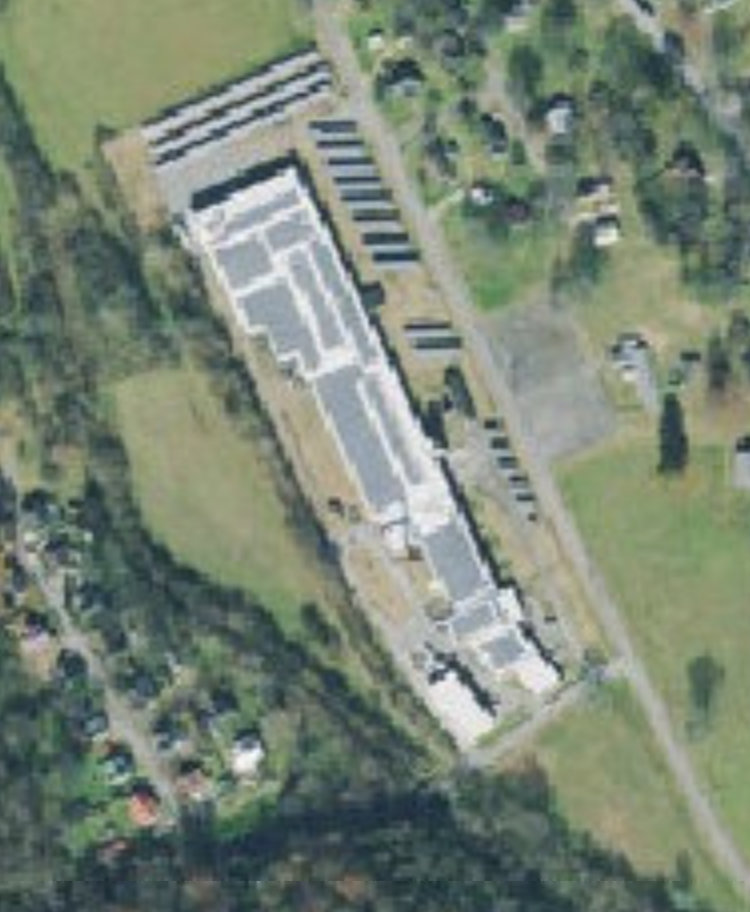
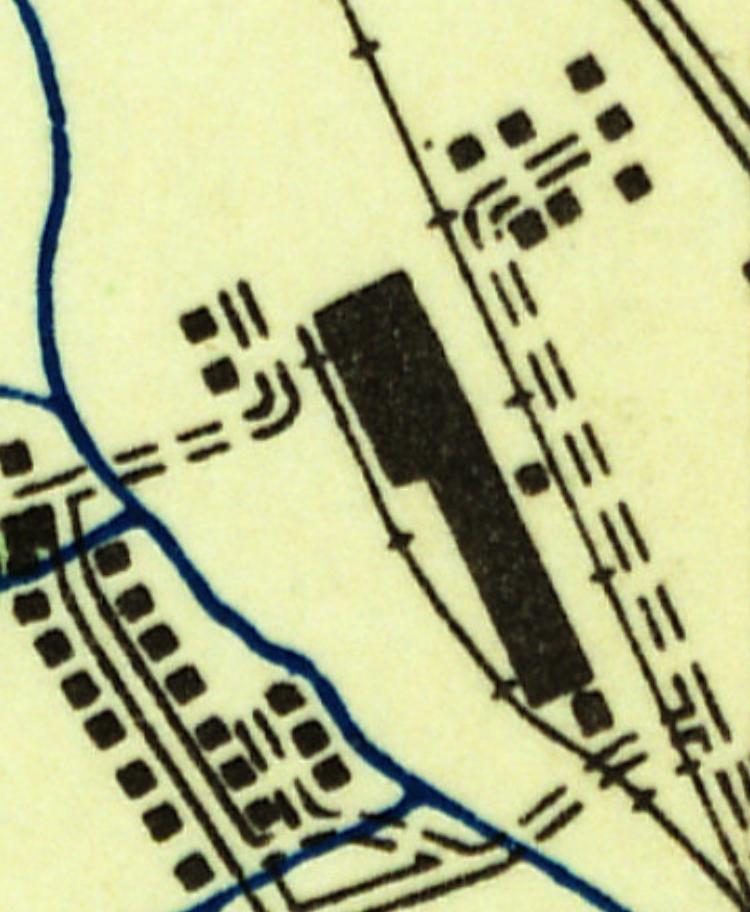
Recent aerial photograph of the mill and its grounds1936 USGS topographic map of the same groundN ↑

About 360 meters (1,200 feet) across, north at the top. The old maps were drawn by hand, so buildings can sit a little off the photo.

Then over now

Each old map is laid over a recent aerial photo at the same scale. Pick a year, then slide to fade between the map and today.

Today1936 map

1936The railroad main line (the line with cross-ticks) runs down the east side of the mill. The mill’s own siding runs along the west side and curves around the south end to rejoin it.

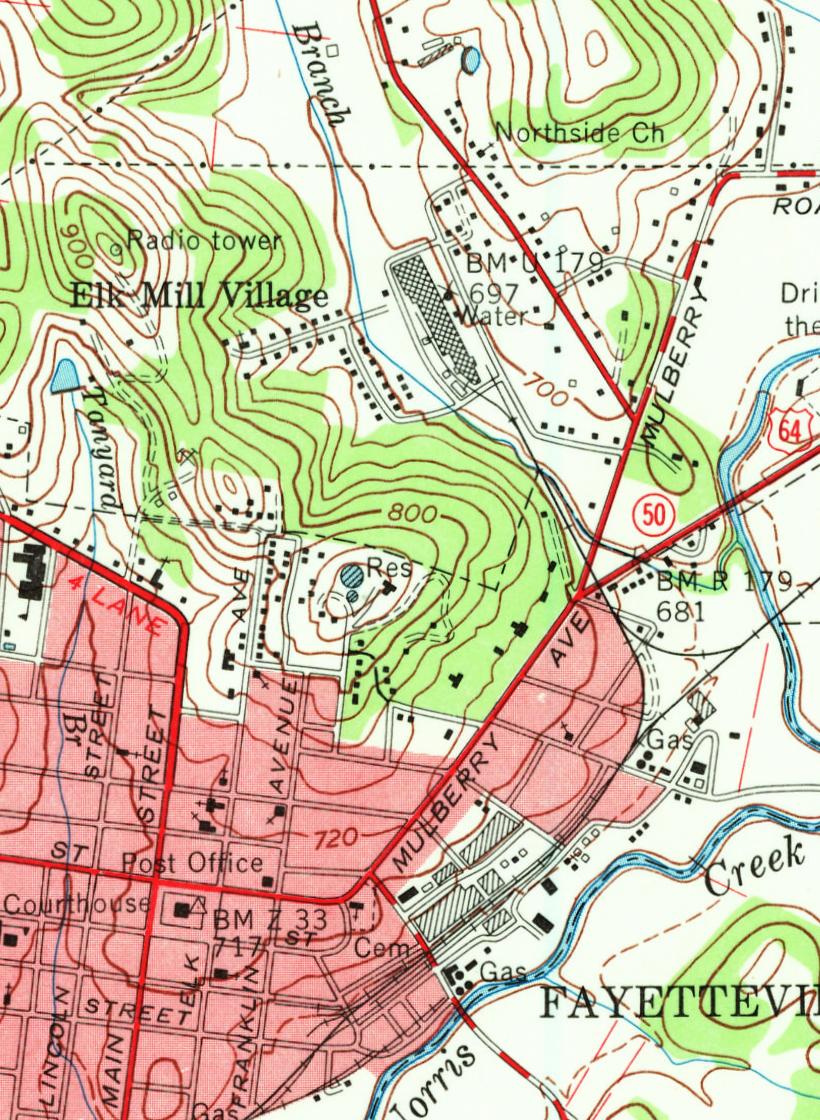
1966 USGS topographic map showing the Elk Mill Village and the mill at the top, the rail line running southeast toward town, and downtown Fayetteville with the courthouse at the bottom
The mill and Elk Mill Village (top) and downtown Fayetteville (bottom) in 1966. By then the track came up from town and stopped at the mill. U.S. Geological Survey, Fayetteville quadrangle, 1966.

The railroad and the mill

  1. 1900

    The mill was built on a farm beside the Nashville, Chattanooga & St. Louis line north of town. A railroad supervisor staked off the switch for the mill’s own track before the walls went up.

  2. 1914

    The fire insurance map shows the main line on the east side of the mill and the mill’s siding along the west wall of the spinning room, with loading platforms from the mill and the cotton warehouses.

  3. 1949

    Rail cars still came right to the building on the mill’s own spur.

  4. 1960–61

    The railroad asked to abandon the line north of Fayetteville. Federal regulators held hearings in Lewisburg in June 1960 and approved closing about 20 miles of it on March 28, 1961. The last train ran that August, leaving a short stub from town that ended at the mill.

  5. 1985

    The Seaboard System railroad filed to abandon its 38-mile line from Fayetteville to Decherd, ending rail service to the town.

  6. Today

    The rails are gone. Traces of the old track bed may still be found along both sides of the building.

The 1914 fire insurance map in The buildings shows the siding up close. Still a mystery: exactly when the last track to the mill was pulled up. If you remember the trains coming to the mill, please tell us.

Maps: U.S. Geological Survey, Fayetteville, Tenn. 7.5-minute quadrangle, 1936, 1951 and 1966 editions. Aerial photo: USDA and USGS, The National Map orthoimagery. Public domain.

Share your mill story

Tell us what you remember

If you or your family worked at the Elk Cotton Mills, we'd like to hear from you. Stories, names, dates, photos, all welcome.

Sources: Nashville Banner, Nashville American and The Tennessean, 1900–1997 · Chattanooga Daily Times and Chattanooga News, 1900–1963 · Lincoln County News, c. 1904–1927 · Commercial Appeal (Memphis) · Knoxville News-Sentinel · Associated Press, 1997 · Tennessee Encyclopedia, “Lincoln County” · Library of Congress, National Child Labor Committee Collection (Lewis Hine, 1910) · Library of Congress, Sanborn Fire Insurance Map of Fayetteville, April 1914 · Sanborn Map Company, Fayetteville, 1926, 1944 and 1959 editions · Lincoln County property records · Richmond Virginian, August 8, 1915 · The Nashville Tennessean, November 23, 1924 and May 30, 1949 · Trainman News, June 13, 1949 · Madison Daily Leader, May 1, 1909, via Chronicling America · Library of Congress, Sanborn Fire Insurance Map of Fayetteville, June 1907 · Manufacturers' Record, 1915 and 1923 · Textile World, 1909 and 1915 · Tennessee Historical Commission, historic resources survey, 1978 · Society of Paper Money Collectors national bank records and FDIC BankFind · Tennessee Court of Appeals, 742 S.W.2d 638 (1987) · U.S. EPA Facility Registry · Federal Register, March and April 1997 · Joe Manning, Lewis Hine Project · Elk Valley Times · U.S. Geological Survey topographic maps, 1936, 1951 and 1966 · USDA and USGS orthoimagery, The National Map · Huntsville Times, August 23, 1985 · National Park Service, Belfast Depot National Register nomination

Cotton Mill District

The Elk Cotton Mills, on Cotton Mill Road since 1900. A working mill, restored one building at a time.

Find us

228 Cotton Mill Rd
Fayetteville, TN 37334

Elk Cotton Mills · Built 1900Fayetteville, TennesseeSign in

Scripture quotations taken from The Holy Bible, New International Version® NIV®. Copyright © 1973, 1978, 1984, 2011 by Biblica, Inc.™ Used by permission. All rights reserved worldwide.